

I look back like Orpheus did every day.
if he's a fool, then I am too.
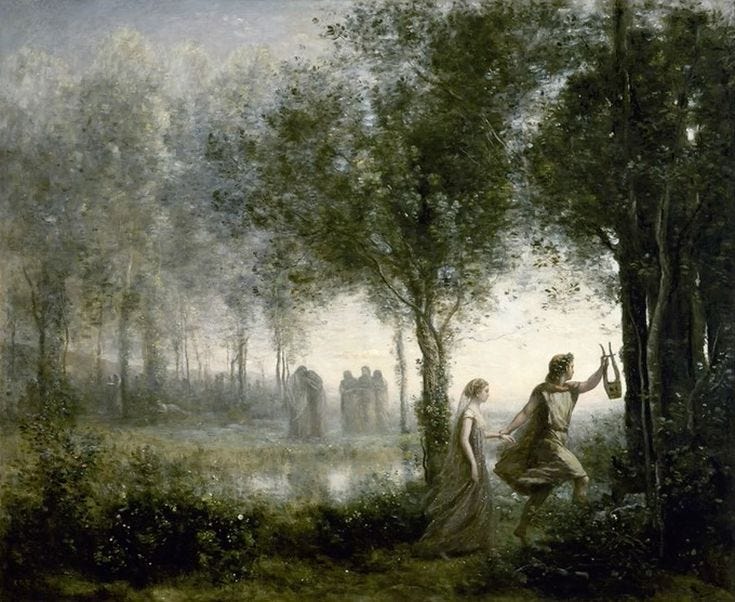
Before I graduated from college, my best friend and I took a trip to New York to see Jordan Fisher in Hadestown, one of my favorite musicals of all time. It retells the myth of Orpheus and Eurydice, from the moment they meet until their final glance.
This isn’t the point of this post, but Jordan Fisher’s Orpheus was transcendent.
My friend went into the show without knowing anything about Orpheus and Eurydice. Having seen the show before in 2019 as well as being taught the myth in high school, I knew what was in store. I eagerly awaited her reaction to the moment when Orpheus looks back at Eurydice as they ascend from the underworld. Right as Orpheus whipped around to see Eurydice, my friend gasped—as did many people in the theater.
Even I did.
As we walked back to Grand Central to catch our train back to our college town, my friend and I discussed the ending.
“So, he just looked back?” I remember her saying. “He just needed to keep walking. It’s not that hard!”
It seems so silly. All Orpheus had to do to save Eurydice was lead her out of the underworld without looking back. But he couldn’t, he had to look back and see her. To know she was there the entire time.
And he lost her forever.
I remember proposing ways that Orpheus could’ve made sure Eurydice was still behind him: what if she had her hands on his shoulders like a conga line? Or if they held hands? Or if they just talked as they walked?
“If I were Orpheus,” I said confidently. “I wouldn’t have looked back. I know better.”
I said that with such conviction because I believed it. If I had the chance to save my lover from an eternity in the underworld, I wouldn’t mess that up. Especially if the only thing I had to do was walk in front of her and not turn around.
But that misses the point of the story, right? Because it’s not about the physical act of Orpheus looking back at Eurydice—it’s about what doing that means.
Orpheus had done the impossible—he made the dangerous journey to the underworld and made a deal with Hades to let Eurydice go—and he was so close to succeeding. He was a mere footstep away from returning to the life he and Eurydice once shared. And he couldn’t think of a better way to celebrate their new beginning than looking into the eyes of the woman he loved.
Forgetting that doing so would curse her back to the underworld forever.
He didn’t look back because of weakness. He did because his love felt stronger than any god, any law, any power that stood against him. But he lived in a world bound by a reality that was never in his favor.
It’s easy to scoff at his decision because the consequence of it was, arguably, pretty avoidable. And yet, I understand why he did.
Because I look back like Orpheus did every day.
Why else would I go through old love letters? Listen to songs I once sent to her? Flip through a book she bought for me? Look at old photos of us? Read old text messages of her telling me she loved me?
Because my love was all-consuming. It conquered my fears. It defined me.
And it wasn’t enough.
It’s over and been over for quite some time, but I still think about it. I am still standing at the edge of the underworld, looking back at what was once everything to me. I am watching it slip back into the grips of Hades, and I’m left there alone. I can only relive it by playing my music composed from memories.
I once believed Orpheus was a fool. But if that’s true, then I am too.